

Airworthiness without the paperwork
AD tracking, maintenance decisions, full audit trail — EASA-ready without the weekend work.
Learn more →AI-powered operational intelligence for regulated industries — where "why" matters as much as "what".
AD tracking, maintenance decisions, full audit trail — EASA-ready without the weekend work.
Learn more →From ISM to parts inventory — know what needs action and prove it to the inspector.
Learn more →AI analyzes, recommends, and documents every conclusion — defensible in court, auditable by client.
Learn more →Portfolio optimization with every recommendation traced, justified, and ready for stakeholders.
Learn more →The Problem
Most AI implementations rely on experimental pipelines, scripts, or loosely connected automation tools. They work — until someone asks:
At that point, "it was AI" is not an answer.
How It Works
Connect your data, logs, documents, and systems. AI structures the operational chaos.
Get recommendations with full context — what, why, and what if. Human oversight at every critical point.
Every decision traced, every output auditable. Regulator-ready by design, not by accident.
Why Sentravera
While others give you AI "assistants," we give you governed execution.
Built on IKSO — our control and execution layer that ensures every AI-driven process is policy-governed, fully traceable, audit-ready, and human-accountable.
EU AI Act aligned by design.
Explore the IKSO architecture →Under the Hood
For teams who need to understand how governed execution works under the hood.
AI systems increasingly operate as complex operational workflows that combine models, APIs, internal services and enterprise systems. IKSO introduces a platform model designed to govern how these components interact. The platform separates applications, execution runtime, and governance controls. Conceptually, IKSO acts as a control and execution layer for AI operations, positioned between enterprise applications and underlying AI infrastructure.
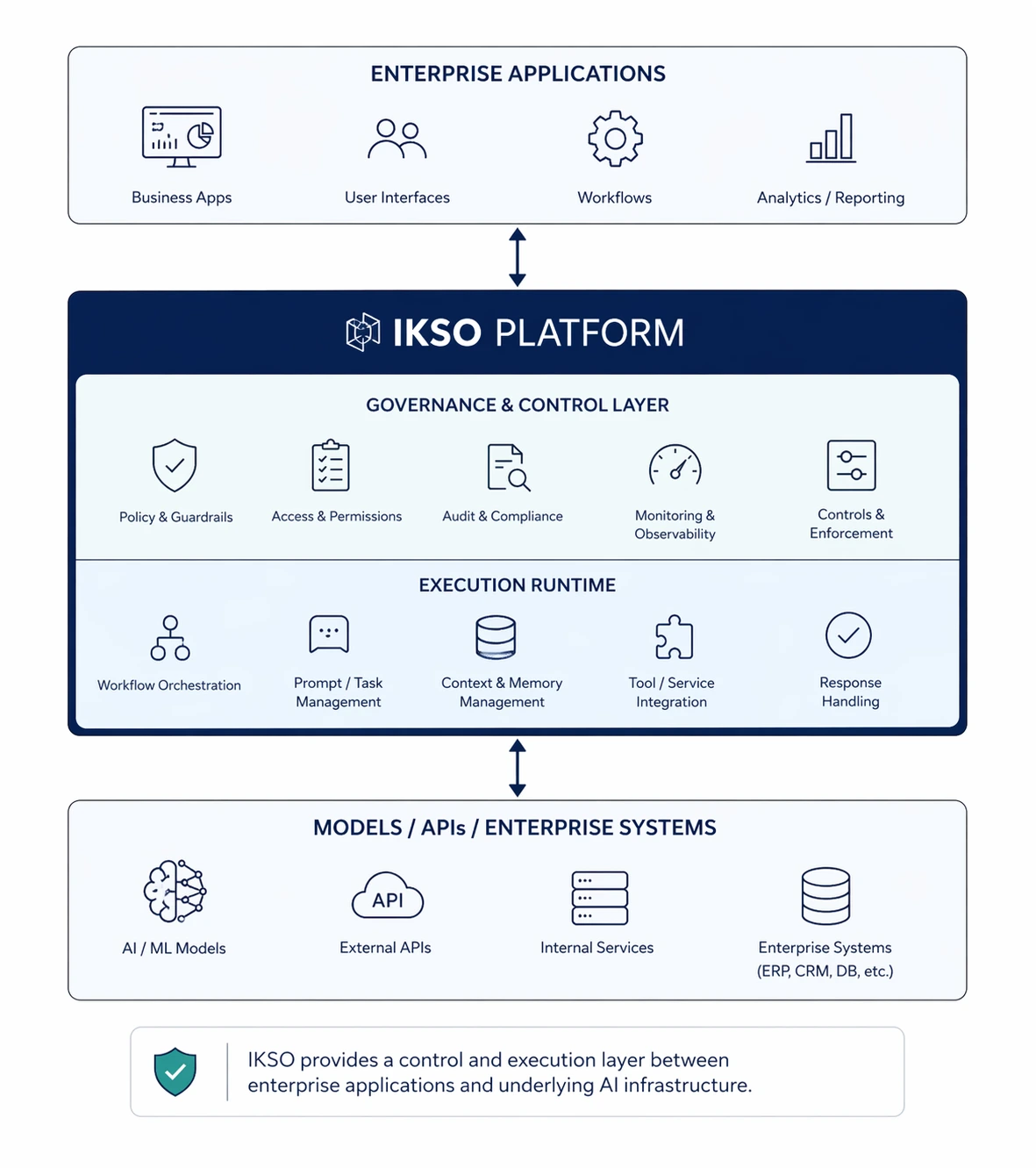
As organizations introduce AI agents and automation into operational environments, maintaining control becomes critical. IKSO is designed around a control-first model for AI execution.
Instead of allowing AI systems to act autonomously without oversight, the platform introduces policy-governed execution rules and restricted capability access based on permissions.
Controlled interaction between AI agents and enterprise systems helps ensure operations remain aligned with organizational policies and governance frameworks.
Workflow execution is recorded with structured traces, and system actions and decisions are linked to execution context so operational changes and transitions can be reconstructed.
The platform generates audit-ready records for review and compliance in operational and regulatory environments.
IKSO helps organizations structure AI operations so responsibilities are transparent across roles such as AI provider, AI deployer, system integrator, and operator of AI-driven processes.
This is particularly important in regulated environments and under emerging frameworks such as the EU AI Act.
IKSO supports structured human oversight points, confirmation and review mechanisms for sensitive actions, revision-safe execution handling, and structured failure classification with operational diagnostics.
These controls allow organizations to introduce AI into operational environments while maintaining human accountability and system reliability.
Organizations operating AI systems under the EU AI Act or equivalent frameworks need more than policy documentation — they need operational infrastructure that supports traceable execution, human oversight, and audit-ready evidence generation.
IKSO is designed to help regulated teams operationalize EU AI Act-aligned governance workflows: capturing execution context at every step, supporting human review checkpoints for sensitive decisions, enabling clear accountability across AI provider, deployer, and operator roles, and maintaining reviewable records for ongoing monitoring and incident assessment.
This positions IKSO as an operational evidence layer for organizations building EU AI Act readiness into their AI operations — without making certification or formal compliance guarantees.
The IKSO platform integrates with models, enterprise systems and operational tools.
Organizations can connect AI models, internal APIs, enterprise data platforms, automation services, and operational systems.
These components operate within structured workflows executed inside the governed runtime environment.
Rather than replacing existing systems, IKSO acts as a coordination and control layer that allows AI-driven processes to interact with enterprise infrastructure in a controlled and traceable way.
Book a 20-minute demo. See how it works in your operational context.
— Sentravera design partners