

Resources
Enterprise AI Operations Guide
Running AI systems in enterprise environments requires more than experimentation. It requires operational discipline, visibility, and structured execution. Many organizations successfully prototype AI systems but face new challenges when these systems begin operating within real business processes.
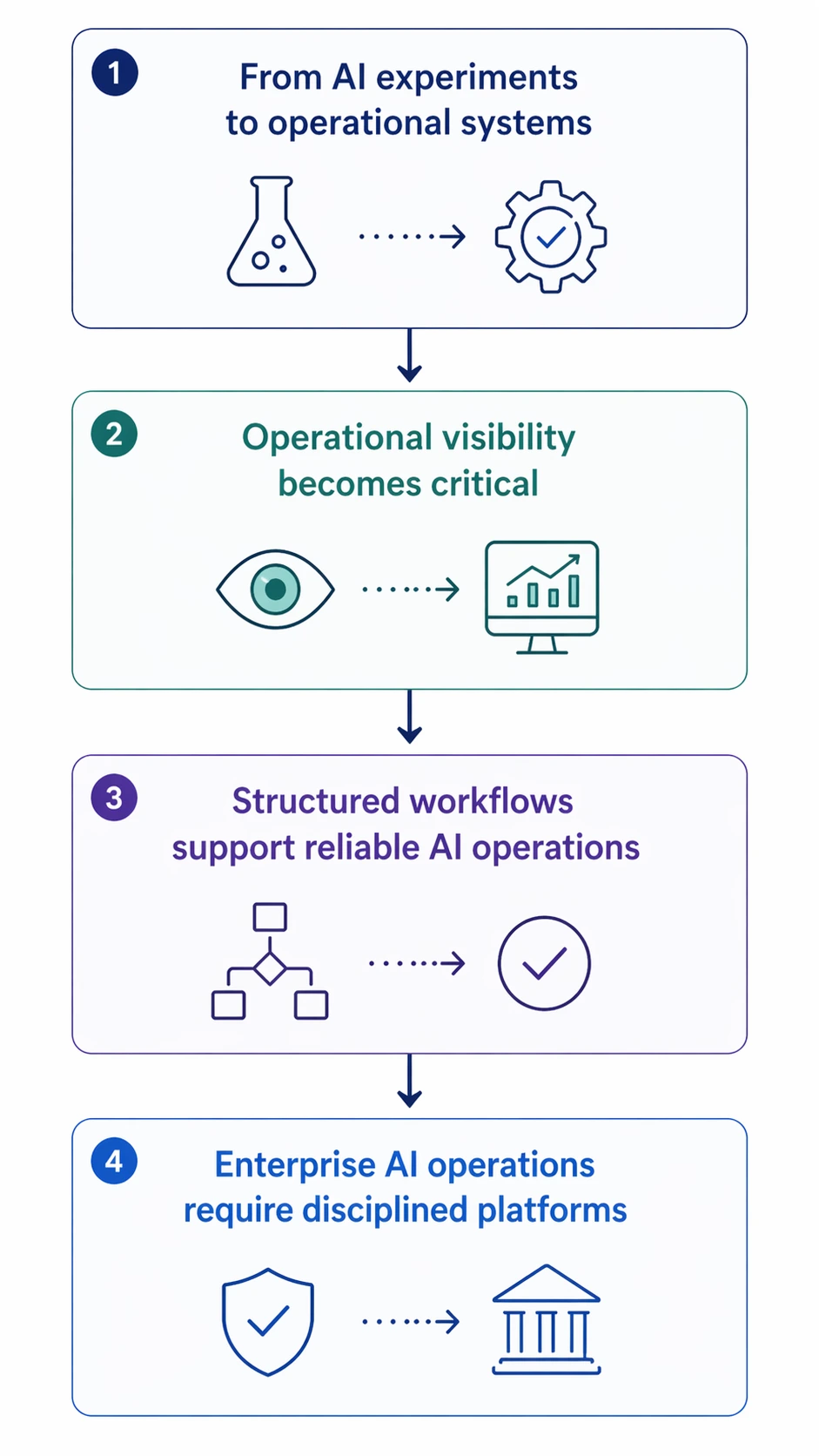
From AI experiments to operational systems
Early AI adoption often emphasizes experimentation and proof-of-concept activity.
Operational AI requires structured platforms that support consistent, controlled execution across real business environments.
IKSO is positioned for organizations making this shift from isolated experimentation to managed operational systems.
Operational visibility becomes critical
Once AI-enabled processes are deployed into production, organizations need practical visibility into how those processes behave.
Operational visibility supports better oversight, clearer accountability, and more informed operational decisions.
IKSO is oriented toward this visibility-first approach to enterprise AI operations.
Structured workflows support reliable AI operations
Enterprise AI operations benefit from structured workflow models that improve clarity and repeatability.
These models can help teams coordinate AI-enabled processes with stronger oversight and operational consistency.
IKSO is relevant where organizations require disciplined workflow operation as AI usage scales.
Enterprise AI operations require disciplined platforms
Organizations evaluating AI platforms increasingly look for systems designed for operational discipline, not only experimentation speed.
Reliable AI operations typically depend on controlled execution and governance-aware operational structure.
IKSO is framed for enterprise environments that prioritize long-term operational maturity.
Explore the platform capabilities
Continue into platform and technology perspectives, or connect with us about enterprise AI operations priorities.